How Drone Spreading Solutions Are Changing Fertiliser and Seed Application
For years, getting fertiliser, seed, or slug pellets onto a field meant either walking it with a back-mounted spinner or paying for a tractor and a big spinner. Both options work, but both have limits. A tractor can compact wet soil, and a walking operator can only cover so many hectares in a day. I have seen farms where the same field gets a variable-rate spread one year and a blanket broadcast the next, simply because the equipment available could not handle the prescription map. That is where drone spreading solutions have started to fill a real gap.
Agricultural drones have been spraying for a while now, but the move into spreading dry material is newer. The same principles apply: a drone flies low over the crop, carries a hopper instead of a tank, and releases granules through a spinning disc or a metered gate. The difference is that dry material behaves differently from liquid. It clumps when damp, it drifts in wind, and it needs a different kind of calibration. The companies that make the hardware - DJI with the Agras T50, XAG with the P100 Pro, and even the legacy Yamaha RMAX - have all had to rethink their spreading mechanisms to handle things like cover crop seed, granular fertiliser, and even copper fungicide in powder form.
Why a drone for spreading makes sense on UK farms
UK fields are not always huge American squares. They are often oddly shaped, sloping, or split by hedges and ditches. A tractor can still do the job, but it might need to turn a lot, waste time on headlands, or cause compaction on wet clay. A drone does not care about hedges. It flies over them. It does not compact soil because it never touches it. And it can follow the exact shape of the field, applying material precisely where it is needed, not where the tramlines happen to run.
There is also the timing factor. After a wet winter, the ground might be too soft for a tractor for weeks. By the time it firms up, the window for a particular fertiliser application or a cover crop drill might have passed. An agricultural drone can fly as soon as the rain stops and the wind drops below about 12 mph. That can make the difference between getting a decent green cover or a thin, patchy one. I have spoken to a grower in Norfolk who used a drone to spread oilseed rape into standing wheat stubble in late August, and he said the establishment was as good as anything he had got from a tractor-mounted spreader, and without the compaction.
Hardware and the practical differences
The DJI Agras T50 is probably the most visible machine in UK fields right now. It can carry up to 50 kg of seed or fertiliser, and its spreading system uses a pair of spinning discs that fling the material outwards. The rate is controlled by a gate that opens and closes based on the flight speed and the prescription map. The XAG P100 Pro takes a slightly different approach, using a metered screw feed instead of a spinning disc. Both work, but the screw feed seems to handle slightly damp fertiliser a bit better, while the disc system is simpler to clean. The old Yamaha RMAX is still around on some estates, mostly for spraying, but its payload is smaller and its control system is older. It is a reliable machine, but for spreading, the newer platforms are more capable.
None of this hardware works well without good positioning. RTK positioning gives the drone sub-inch accuracy, so it knows exactly where it is relative to the field boundary and the prescription zone. Without RTK, a drone can drift off course, especially in gusty conditions, and then the spread pattern gets uneven. GPS guidance on its own is fine for blanket applications, but variable rate application needs the precision that RTK provides. Some operators also use LiDAR to map the field surface and adjust the drone's height above the crop, keeping the spread pattern consistent even when the ground undulates.
Regulation and certification you need to know
Flying a drone for commercial spreading in the UK is not something you can just do with a toy bought online. The Civil Aviation Authority sets the rules, and anyone operating a drone for work needs a PfCO or an A2 CofC, depending on the weight of the machine. The heavy agricultural drones like the Agras T50 fall under the specific category, which means you need an operational authorisation from the CAA. That involves submitting a safety case, showing your risk assessments, and proving you can fly safely. On top of that, if you are spreading fertiliser or plant protection products, you need to be BASIS or NRoSO qualified, or at least work under the supervision of someone who is. The HSE also has a say, because spreading materials like slug pellets or copper fungicide falls under pesticide regulations. DEFRA has issued guidance on using drones for agricultural spreading, and it is worth reading that before you start, because it clarifies what counts as a plant protection product and what does not.
I have seen some operators skip the BASIS training and then run into trouble when they spread a fertiliser that turns out to be a regulated product under the new rules. It is not worth the risk. Get the certs, keep the records, and make sure your drone operator has the right permissions. The CAA does inspect, and they will ground you if you cannot show the paperwork.
Practical decisions: what to spread and when
Soil sampling is the starting point for any precision application. Without knowing the nutrient levels across the field, you are guessing. A drone can spread variable rate fertiliser based on a soil map, putting more phosphorus where it is low and less where it is high. The same applies to seed broadcast for cover crops. You might want a heavier rate near the gate where the pigeons have been eating the seed, and a lighter rate in the middle where the ground is already good. The drone can adjust on the fly.
Cover crops are a common use for drone spreading solutions because the timing is often tight. You have just combined the wheat, and you want to get a mix of radish, vetch, and oats in the ground before the autumn rains. A tractor might take a week to cover the whole farm, and by then the weather could have turned. A drone can do it in a couple of days, flying in conditions that would keep a tractor in the shed. I have seen the same approach used for overseeding pasture with clover, where the drone flies low over the grass and drops the seed into the sward without tearing up the existing turf.
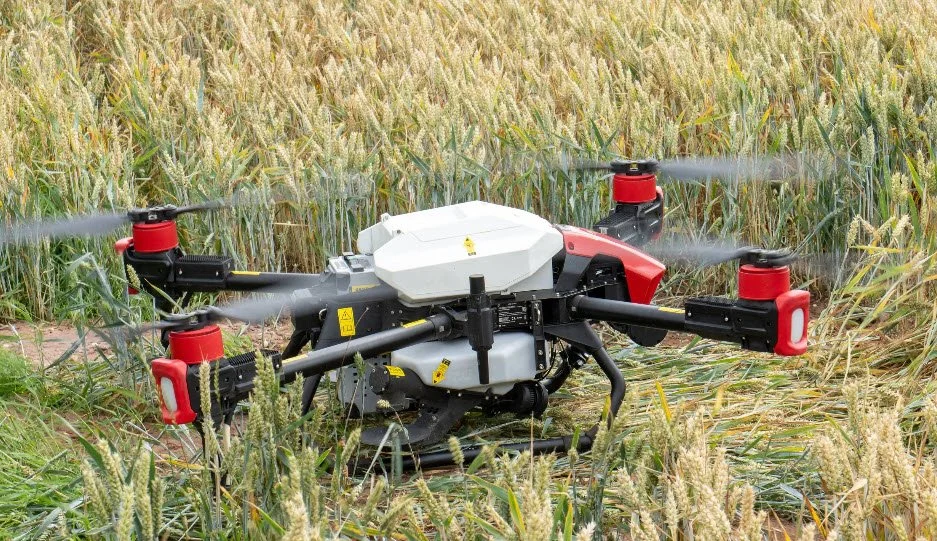
Fertiliser spreading with a drone is more common now, especially for top-up applications on crops that are too tall for a tractor to drive through. Maize, for example, can get a liquid nitrogen top-up by sprayer, but granular fertiliser is harder to apply once the crop is above knee height. A drone flying 3 metres above the canopy can spread urea or ammonium nitrate without damaging the crop. The same logic applies to spreading slug pellets in oilseed rape, where the crop is delicate and the ground is often wet.
Copper fungicide is another material that works well from a drone, especially in fruit crops where the sprayer cannot reach the top of the tree without massive drift. The drone can fly through the rows and apply the powder directly to the leaves, getting coverage that a ground sprayer misses.
Yield benefits and the economics
Does all this precision actually improve yield? It can, but not always. The main gain is often not yield itself but efficiency. You use less fertiliser because you are not wasting it where the soil already has enough. You waste less seed because you are not spreading it on headlands or in wet patches where it will not germinate. And you save time, which in a short UK growing season matters a lot. I have seen data from a farm in Lincolnshire that compared drone-spread variable rate fertiliser against a blanket flat rate. The yield difference was small, maybe 2-3%, but the fertiliser saving was 18%. That is where the money is.
There is also the crop health side. When you apply the right amount of nutrition to each part of the field, the crop grows more evenly, which makes harvest easier and reduces drying costs. The same applies to seed broadcast for cover crops: a uniform stand of cover means better weed suppression and more nitrogen capture, which benefits the following cash crop.
That said, drone spreading is not always cheaper than a tractor. The cost per hectare is higher for the drone if you are only doing a small field, because the setup and flight time do not scale down as well as a tractor's. But on larger fields, or on fields that are difficult to access, the drone can be competitive. The real value is in the precision and the timeliness, not just the headline cost.
Looking at the options
If you are considering drone spreading solutions for your own farm, start with a soil sampling plan and a yield map from previous seasons. That will tell you where the variability is. Then talk to a drone operator who has the right equipment and the right certs. Ask them about their experience with the specific material you want to spread - some drones handle fine seed like clover better than others, and some struggle with high-volume fertiliser rates. And check that the operator has liability insurance that covers spreading operations, because standard drone insurance sometimes excludes it.
The technology is moving fast. The next few years will probably bring bigger payloads, longer flight times, and better integration with farm management software. But even now, for many UK growers, a drone is not a replacement for the tractor spreader. It is an extra tool for the jobs that the tractor cannot do well, or cannot do in time. Used right, it can save money, improve yield, and reduce the environmental footprint of the farm. That is a combination worth looking at.